
Wooden Dog Toy Storage Boxes
Best fordog product lines wanting a dedicated toy bin sized for a heavier load
Main review pointinner capacity and board thickness matched to daily use
OEM/ODM WOODEN PET TOY STORAGE BOXES FOR B2B PET PROGRAMS
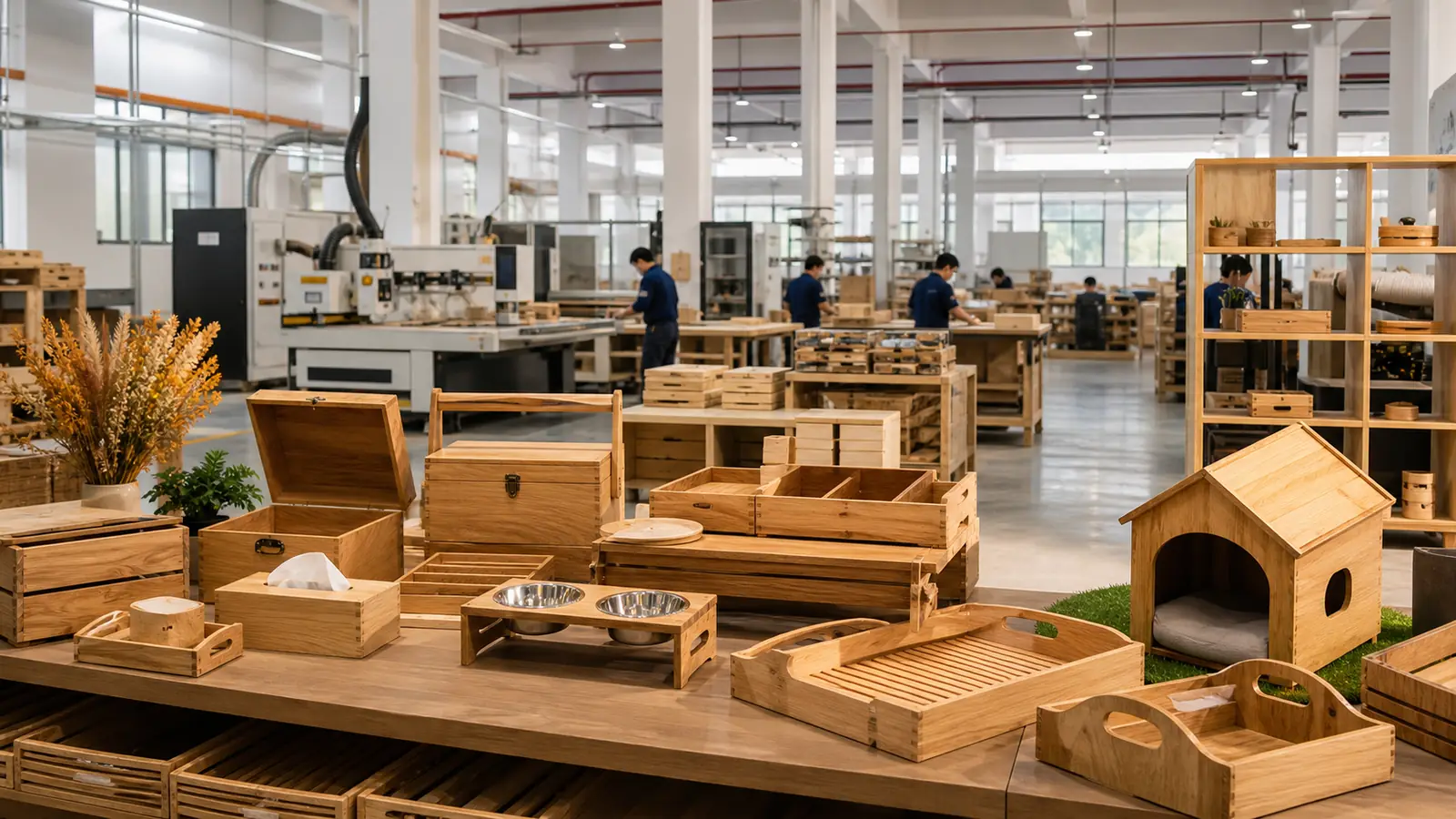
Heze Sunflower builds custom wooden pet toy storage boxes, pet storage bins and wooden pet organizers for pet product brands, home storage brands, importers and private label buyers. A project usually starts with one of these: a reference photo, a CAD drawing, a physical sample box, or just a storage-use and size note.
This page covers what we quote against most often — wooden dog toy storage boxes, cat toy storage boxes, wooden pet storage crates, open-top pet toy boxes, lidded pet storage boxes, and OEM or private label pet storage box programs.
What goes inside the box comes first — that decides inner capacity, outer size and whether an open top or a lid makes more sense. Handle style, edge treatment and logo placement get confirmed on a physical sample before anything ships in bulk.
BUYER ANSWER
Start with the storage use — dog toy or cat toy storage changes inner capacity and outer size before anything else gets decided. Open-top or lidded structure comes next, whether that's a hinged lid or a lift-off lid, followed by handle style: a cutout, a rope handle, or a side grip.
Edge sanding and corner treatment matter for a box that gets handled daily. Logo method, label or barcode placement, private label packing and export carton protection all get confirmed once the structure is set.
PET STORAGE ROUTE FINDER
SIZE, CAPACITY AND STRUCTURE DECISION MATRIX
| Storage box area | Common buyer risk | Review before sample | Production record |
|---|---|---|---|
| Storage use | Box gets built for the wrong contents — toys vs. leashes vs. mixed supplies | Confirm what's actually going inside before fixing the inner shape | Storage use note kept with the approved sample |
| Inner capacity | Too small for the intended load, or wastes shelf space | Measure real items against inner space, not just an assumed volume | Inner dimension spec kept on the cutting file |
| Outer size | Doesn't fit a buyer's shelf, cart or existing product line footprint | Confirm outer size against the sales environment it's going into | Outer size logged in the spec sheet |
| Board thickness | Panels flex or sag under a full load | Match thickness to expected weight and handling frequency | Panel spec recorded on the cutting file |
| Open-top structure | Wall height is wrong for reach-in access or stacking | Check wall height against both hand access and shelf stacking plans | Structure confirmed on the approved sample |
| Lid route | Hinge binds, lid doesn't sit flush, or a lift-off lid gets misplaced | Test the chosen lid style by hand on a physical sample | Lid type and fit noted in the spec sheet |
| Handle route | Handle cutout is too small, or a rope handle wears through | Test handle strength under a loaded box, not an empty one | Handle type and position kept with the sample |
| Edge sanding | Rough edges or corners on a box that gets handled daily | Run a hand check on all edges and corners on the sample | Sanding standard noted for reorders |
| Logo / label | Logo shifts position or the label doesn't read clearly at production scale | Proof the logo or label at actual size on the finished surface | Artwork file kept on record |
| Export packing | Corners crush or surfaces rub in transit | Check corner protection and surface wrap against the box's weight | Packing photos kept per order |
SIZE AND CAPACITY ROUTE
Sized against actual toys or supplies, not a generic volume estimate.
Set against the shelf, cart or retail display the box is going into.
Usually needs a deeper, higher-capacity build than a cat-focused box.
A smaller footprint that still needs enough depth for toys and grooming items.
Toys, leashes, blankets and small accessories together need a wider inner layout.
Wall angle and lip design get checked when boxes need to stack or nest for retail display.
HANDLE AND LID ROUTE
Cutout size and edge shape are tested by hand-carrying a loaded box, not just measured on paper.
Rope thickness and anchor point are matched to expected carrying weight.
A recessed grip along the side panel, useful when a full handle cutout isn't wanted.
No lid to manage, but wall height needs checking against both reach-in access and stacking plans.
Stays attached to the box, practical for a lid that gets opened often.
Simple and low-cost, but needs a stable seat so it doesn't shift when the box is picked up.
EDGE, CORNER AND SURFACE ROUTE
Edge treatment and finish get checked against the buyer's own spec and target-market notes on the physical sample — this describes a finishing review, not a child-safe, pet-safe or toy-safe certification claim. Share a specific testing requirement and we'll check the structure against it.
Checked by hand on every edge that gets touched during daily use.
Reduces sharp points on the corners that see the most handling.
Sanded and finished separately so nothing catches on toys or supplies stored inside.
Thickness and support match the expected load so the base doesn't sag over time.
Small feet or a raised base can reduce floor contact wear and moisture pickup.
Checked during packing review so the finish doesn't scuff during transit or shelf handling.
MATERIAL, FINISH AND LOGO ROUTE
Pine, paulownia, poplar, plywood, MDF, bamboo, rubberwood and veneer panels cover most programs, chosen by box size, load and finish target.
Water-based paint, clear lacquer, natural oil, stained finish, matte finish and burned finish where applicable each change surface feel and how the color holds up under daily handling.
Laser engraving, screen printing, UV printing, branding, a printed label or a metal plate — chosen to match the surface finish underneath it.
PRIVATE LABEL PACKING
Signed off on position, size and contrast before the production run starts.
A printed card packed inside carries brand information without altering the box surface itself.
Each size and finish combination gets its own SKU and barcode placement.
Outer sleeve or presentation box tested for fit around the finished unit.
Item code, quantity, gross weight and destination marks printed to the buyer's carton format.
Approved sample, artwork file, finish note and packing spec kept on file for the next order.
QUALITY CONTROL MATRIX
| QC area | Common issue | Review point |
|---|---|---|
| Inner capacity | Box doesn't hold the intended load or contents | Measure inner space against the confirmed storage use |
| Panel fit | Panels gap or don't sit flush at assembly | Check panel alignment and joinery against the approved sample |
| Lid fit | Lid doesn't seat flush or the hinge binds | Test lid movement and fit by hand on the finished unit |
| Handle strength | Handle cutout tears or rope handle wears through | Load-test the handle on a filled box |
| Edge sanding | Rough edges or splinters on touch points | Run a hand check on all edges and corners |
| Surface finish | Color drift or uneven coverage | Compare against the approved finish sample |
| Logo and label | Logo shifts position or barcode is unreadable | Check logo placement and label print quality |
| Packing | Surface rub or a missing insert card | Check wrap, insert card and carton marks before sealing |
| Carton marks | Wrong quantity, item code or destination mark | Verify carton marks against the order file |
EXPORT PACKING FLOW
The buyer signs off on size, structure, handle and lid fit on one physical unit.
Inner capacity and panel fit are checked against the approved sample before the run starts.
Edges, corners and surface finish are checked by hand across the sample run.
Logo placement and label print quality are compared to the approved proof.
Finished surfaces are wrapped separately so they don't rub against each other in transit.
Insert card, sleeve or retail box is fitted and cushioned around the unit.
Item code, quantity and destination marks are printed to match the order file.
Photos of the packed cartons and the loaded container are kept for the buyer's reference.
BUYER SCENARIOS
Wants a storage box that matches other product lines in finish and repeats cleanly across a size range.
Needs a higher-capacity build with handle strength tested under a realistic load.
Needs a compact footprint without losing usable depth.
Needs retail-ready packaging, SKU control and a listing-ready finish.
Wants a box that reads as home furniture first and pet storage second.
Wants a documented spec file and export packing that holds up across a full container load.
RELATED PRODUCTS
Compare related pet storage formats, then use the support pages for sampling, quality control and export packing.
PROJECT START
A finished technical drawing helps but isn't required to get a first quote moving. A photo, a rough size note, and what the box needs to hold are usually enough for us to sketch a structure and a price range, then tighten the details from there.
BUYER FAQ
Storage use, dog toy or cat toy route, inner capacity, outer dimensions, open-top or lidded structure, board thickness, handle route, edge treatment, material and finish, logo method, label or barcode, packing style, quantity and destination market get you the fastest quote.
Yes. A reference photo, a PDF, a CAD file or a physical sample box is enough to start working out inner capacity, structure and handle route.
Yes. Dog toy boxes are usually reviewed for a deeper inner capacity and handle strength suited to a heavier daily load.
Yes. Cat toy boxes get a smaller footprint while keeping enough depth for toys and grooming items.
Yes. Wall height and stacking fit are checked against how the box will sit on a shelf or in a retail display.
Yes. Hinged lid and lift-off lid structures are both available, with lid fit tested on the physical sample.
Yes. Handle cutout, rope handle and side grip are all options, load-tested on a filled box before the full run.
Yes. Laser engraving, screen printing, UV printing, branding, a printed label or a metal plate can all be proofed on the sample surface.
Pine, paulownia, poplar, plywood, MDF, bamboo, rubberwood and veneer panels are common choices, finished with water-based paint, clear lacquer, natural oil, stained finish, matte finish or a burned finish where applicable.
Yes. Logo proof, an insert card, SKU and barcode placement, a retail sleeve or box, and carton marks are handled together for private label programs.
Sample approval and a size/structure check come first, then an edge and surface check, a logo/label check, surface protection, inner or retail packing, carton marks and a loading record.
No — storage use, size, structure, handle route, material, finish, logo method and packing style all shift the cost enough that each program gets quoted individually.
PROJECT REVIEW
Send storage use, box size, handle preference, lid structure, edge treatment, material and finish, logo method, packing style, quantity and country. We'll work out the structure, handle fit and export packing plan before quoting.