
Custom Wooden Planter Boxes
Best forgarden brands wanting a size range built to their own spec rather than a stock catalog
Key detaillength, width and height matched to the buyer's target planting use
OEM/ODM WOODEN PLANTER BOXES FOR B2B GARDEN PROGRAMS
Send your target size or a reference photo and tell us where the planter will sit—on garden soil, a patio, a balcony or in a retail display. We’ll confirm wall thickness, drainage, liner or tray options, base clearance and packing before sampling.
You do not need a finished drawing. A rough length, width and height, together with the expected soil load, is enough for us to start checking the structure.
We use the sample to confirm the inner dimensions, bottom support, drainage-hole layout, liner fit, raised feet and finish for the stated exposure level.
PLACEMENT AND SOIL LOAD
Tell us whether your custom wooden planter boxes will sit in garden soil, on a patio, on a balcony or in a retail display. We start with outer and inner dimensions, wall thickness, the expected soil load, and whether you want solid panels or slats.
We then set the drainage holes, liner or tray, bottom panel, raised feet and finish sample. Logo, flat-pack or assembled packing, retail packaging and export cartons are confirmed against the sales channel and destination.
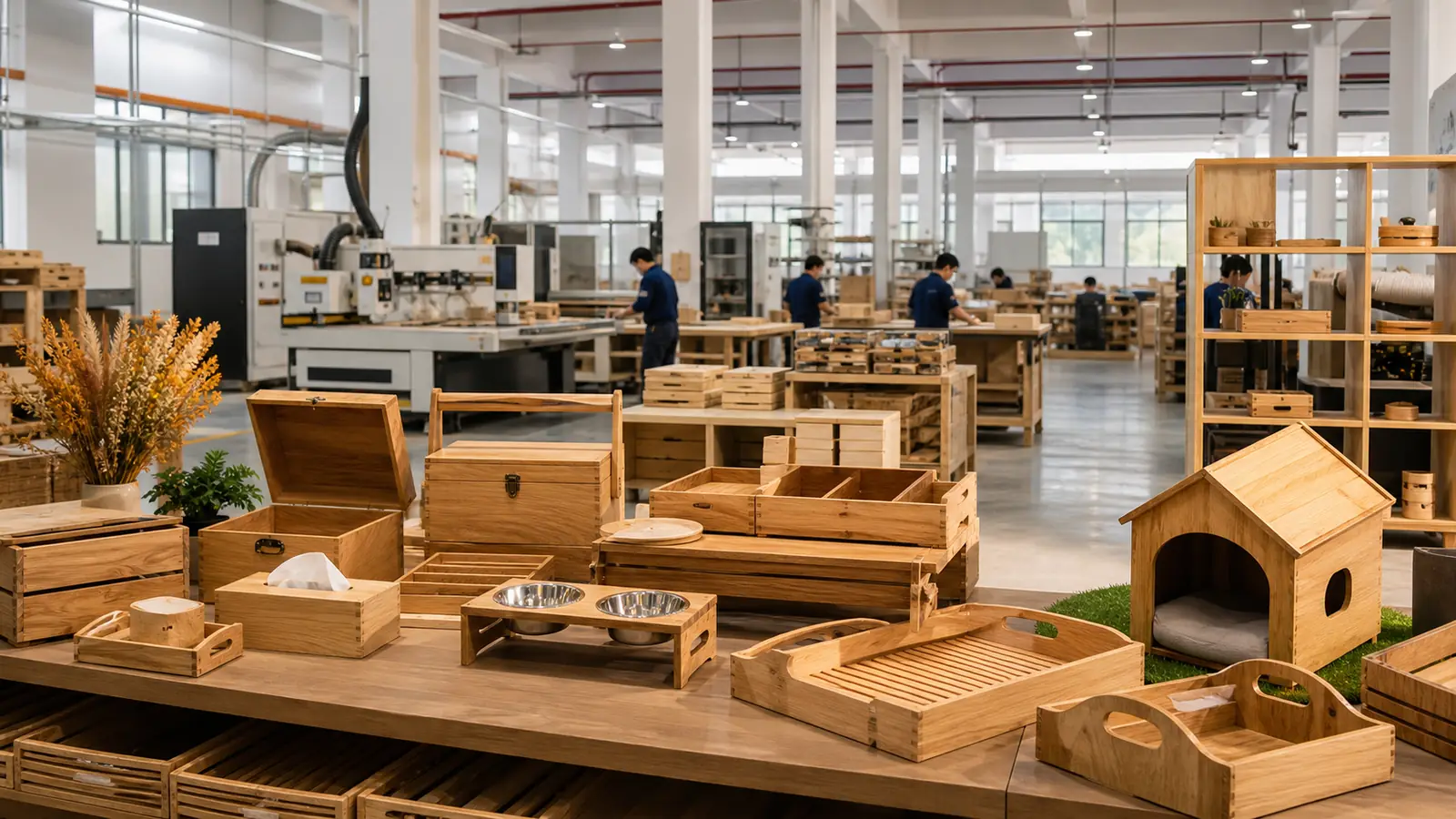
PLANTER BOX OPTIONS
SIZE AND SOIL SUPPORT
| Planter box area | Common buyer risk | Sample check | Approved specification |
|---|---|---|---|
| Product use | Structure doesn't match the intended planting or display use | Confirm product use before fixing size and structure | Use note kept with the approved sample |
| Length / width / height | Overall size doesn't fit the buyer's intended space | Confirm all three dimensions against the actual placement, not just a stock size | Dimension spec kept on the cutting file |
| Wall thickness | Panels flex or feel undersized once filled with soil | Match thickness to the box size and expected soil weight | Panel spec recorded on the cutting file |
| Solid or slat structure | Buyer expects one panel style but receives the other | Confirm solid panel or slat structure before cutting | Structure type noted with the sample |
| Drainage holes | Holes are missing or placed wrong for the intended plant or soil type | Confirm hole size and position against the buyer's planting plan | Drainage layout recorded with the structural drawing |
| Inner liner or tray | Liner doesn't fit the confirmed inner dimensions | Check liner fit against the box's actual inner space on the sample | Liner spec kept with the approved unit |
| Ground contact | Base panel picks up moisture faster than expected | Check base structure and any raised feet against the buyer's placement plan | Base structure confirmed on the approved unit |
| Raised feet or base clearance | Box sits flush on wet ground when the buyer expected clearance | Confirm feet or clearance height against the buyer's outdoor use notes | Clearance spec noted for reorders |
| Bottom panel | Bottom doesn't support soil weight evenly | Check bottom panel support against the confirmed box size | Bottom structure kept on the cutting file |
| Finish route | Finish doesn't hold up to the buyer's actual use condition | Confirm finish sample against destination market notes | Finish sample kept on file |
| Logo method | Logo doesn't read well on an outdoor or textured surface | Proof the logo on the actual finish before the full run | Artwork file kept on record |
| Private label packing | Packing doesn't match the buyer's retail or wholesale channel | Confirm packing style against the buyer's sales channel | Packing spec kept on file |
| Export packing | Corners crush or surfaces rub in transit | Check corner protection and surface wrap against the box's weight and shape | Packing photos kept per order |
DIMENSIONS AND WALL THICKNESS
A drawing helps, but a photo and rough target dimensions are enough to begin. We use the placement and soil load to propose the wall thickness and bottom support.
Set from the buyer's actual placement space rather than a single stock footprint.
Confirmed against the intended soil depth and plant type.
Matched to the box size and how much soil weight it will carry.
A continuous wall surface, usually chosen for a cleaner outdoor look.
Spaced boards that reduce weight and material use while still holding soil with a liner.
No lid to manage, with wall height set against the buyer's planting depth.
DRAINAGE AND SOIL SEPARATION
Tell us the planting arrangement and whether soil will touch the wood. We confirm drainage-hole size and position, liner or tray fit and bottom support on the sample; no fixed outdoor-life claim is assumed.
Sized and counted against the buyer's planting plan rather than a single default layout.
Set to match how the box will actually sit — flat on the ground, on feet, or on a stand.
A removable liner can be added when the buyer wants extra separation between soil and wood.
An alternative to a fitted liner, useful when the buyer wants to swap plantings without disturbing the box.
Checked for flatness and support against the confirmed soil depth and box size.
Reviewed against the buyer's watering routine and how often the box gets refilled.
BASE CLEARANCE AND OUTDOOR EXPOSURE
Tell us whether the planter will sit on soil, decking, gravel or a covered surface. We use that information to set base clearance, hardware and the finish sample without promising a universal weather-resistance result.
Lift the box off the ground, reviewed for height and stability under a filled load.
Confirmed against the buyer's placement surface — soil, decking, gravel or patio stone.
Checked for how the bottom panel handles direct soil or floor contact.
Reviewed for a more controlled placement, usually with less direct ground contact.
Reviewed for direct ground placement, where base clearance and drainage matter more.
Base design is checked against how the box packs for shipping, not just how it sits in use.
MATERIAL, FINISH AND LOGO
Pine, paulownia, poplar, plywood, bamboo, rubberwood and acacia cover most planter programs; MDF is limited to dry indoor decorative or gift-use planter boxes when the buyer accepts it.
Water-based paint, clear lacquer, natural oil, stained finish, matte finish and a burned finish where applicable each change surface feel and how the color holds up under the buyer's stated use condition.
Laser engraving, screen printing, UV printing, branding, a printed label or a metal plate — chosen to match the surface finish underneath it.
FROM REFERENCE TO SAMPLE
We compare the reference with cutting, assembly, finish and packing requirements before quoting, so the sample reflects the planter you intend to sell.
A clear photo of an existing box or a similar reference is often enough to start the first structure review.
Technical drawings get checked against real cutting and assembly tolerances before quoting.
A sample box can be measured, and if needed taken apart, and matched panel by panel.
Length, width, height and wall thickness are set from the buyer's own target size rather than a fixed catalog range.
Hole layout and liner fit are adjusted to match the buyer's planting plan.
Color, sheen and logo placement are proofed on the actual finish before the full run.
Packing style, SKU and barcode placement are set once the structure is confirmed.
Every confirmed spec is kept on file so a reorder doesn't need to start the review from zero.
PRIVATE LABEL PACKING
Signed off on position, size and contrast before the production run starts.
Assembly wording matched to the buyer's packaging language for flat-pack programs.
Screws and fasteners counted and bagged so nothing short-ships.
Each size, structure and finish combination gets its own SKU and barcode placement.
Retail-ready outer packaging matched to the buyer's channel.
Item code, quantity, gross weight and destination marks printed to the buyer's carton format.
Approved sample, finish note, drainage spec and packing spec kept on file for the next order.
QUALITY CONTROL MATRIX
| QC area | Common issue | Review point |
|---|---|---|
| Overall size | Doesn't match the confirmed spec | Measure length, width and height against the order file |
| Wall thickness | Panels flex or feel undersized | Measure panel thickness against the confirmed spec |
| Drainage holes | Missing or wrongly placed | Check hole position and count against the confirmed layout |
| Liner or tray fit | Liner doesn't seat properly inside the box | Test liner or tray fit on the finished unit |
| Base clearance | Feet height doesn't match the confirmed spec | Measure base clearance against the order file |
| Ground contact | Base sits unevenly or picks up moisture | Check base structure and feet by hand |
| Assembly structure | Panels don't align or hardware is missing | Dry-fit the flat-pack kit before packing |
| Surface finish | Color drift or uneven coverage | Compare against the approved finish sample |
| Logo and label | Logo shifts position or barcode is unreadable | Check logo placement and label print quality |
| Packing | Surface rub or a missing hardware bag | Check wrap, hardware bag and carton marks before sealing |
| Carton marks | Wrong quantity, item code or destination mark | Verify carton marks against the order file |
EXPORT PACKING FLOW
The buyer signs off on size, structure, finish and hardware on one physical unit.
Length, width, height and panel fit are checked against the approved sample.
Drainage holes and liner or tray fit are checked against the confirmed layout.
Feet height, base clearance and ground contact are checked by hand.
Panels are dry-fitted and hardware is checked against the parts list.
Finish consistency is checked by hand across the sample run.
Logo placement and label print quality are compared to the approved proof.
Insert card, sleeve or retail box is fitted and cushioned around the unit.
Item code, quantity and destination marks are printed to match the order file.
Photos of the packed cartons and the loaded container are kept for the buyer's reference.
RELATED PRODUCTS
Use these pages to compare the closest garden format, then confirm sampling, quality control and export packing details.
START YOUR SPECIFICATION
A finished technical drawing is optional. A photo, rough size, soil load and placement let us prepare the first structure and packing questions.
BUYER FAQ
Product type, indoor, patio, balcony or outdoor use, length, width and height, wall thickness, solid or slat structure, drainage hole requirement, inner liner needs, material and finish, logo method, packing style, quantity and destination market get you the fastest quote.
Yes. A reference photo, a PDF, a CAD file or a physical sample is enough to start working out size, structure and finish.
Yes. Length, width, height and wall thickness are set from the buyer's own target dimensions rather than a fixed catalog range.
Yes. Hole size, position and count are set from the buyer's planting plan rather than one fixed layout.
Yes. A liner or tray can be fitted to the confirmed inner dimensions, reviewed on the physical sample before the full run.
Yes. Raised feet or a base clearance detail can be added and checked for stability once the box is filled.
Yes. Smaller-format flower boxes and compact balcony planters are reviewed for drainage, footprint and how they're meant to be positioned.
Pine, paulownia, poplar, plywood, bamboo, rubberwood and acacia cover most programs, with MDF limited to dry indoor decorative or gift-use planter boxes when the buyer accepts it. Finish options include water-based paint, clear lacquer, natural oil, stained finish, matte finish and a burned finish where applicable.
Yes. Logo proof, an instruction sheet, a hardware bag for flat-pack programs, SKU and barcode placement, color box or kraft box packaging and carton marks are handled together for private label programs.
Sample approval and a size/structure check come first, then a drainage and liner check, a base and ground contact check, an assembly or flat-pack check, a surface and finish check, a logo/label check, carton marks and a loading record.
Yes. As a wooden planter box manufacturer working with repeat buyers, we keep the approved sample, drainage spec, finish note and packing record on file so a reorder doesn't need to start the review from zero.
No — size, structure, drainage requirement, liner option, material, finish, logo method and packing style all shift the cost enough that each program gets quoted individually.
REQUEST A QUOTE
Add the target size, placement, quantity and destination. We’ll follow up on drainage, liner, finish and packing where more detail is needed.
START A PLANTER BOX QUOTE
Send the placement, size, soil-load expectation, drainage or liner needs, material, finish, logo, packing, quantity and destination. We’ll prepare the structure, finish sample and export-packing details before quoting.